BRIGHTLINGSEA TREES, Essex.
by Roger Tabor
Native Black Poplar
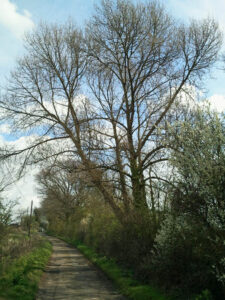
Brightlingsea’s only Native Black Poplar [Populus nigra L.) stands beside the lane called Freelands, within the Coastal Protection Belt & Environmentally Sensitive Area (51.811573, 1.046010). It was identified as Native Black Poplar by Dr Ken Adams FBNA & as a male tree by Roger Tabor FBNAhc. Professor Oliver Rackham FBNAhc called the Black Poplar as “one of the most specifically English trees, noting they are evidently the last shadow of the vanished flood-plain wildwood”. He further noted that “More than any other tree, black poplar reminds us of the splendour of the medieval countryside” when it was then the 5th commonest non-woodland tree mentioned in Essex documents of the time. Now it is a relatively rare tree. Significantly this tree stands at the top of a boat access cut that runs across the saltmarsh to Brightlingsea Creek, providing the moist conditions it prefers. It has distinctive curved branches.
Field Maple
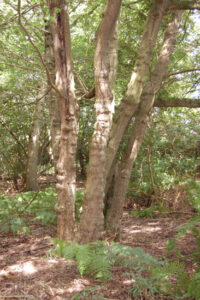
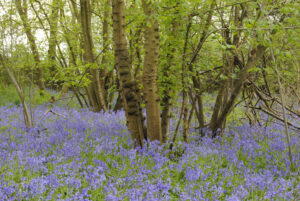 Brightlingsea’s Wicks Wood is a privately owned ancient wood on Lodge Farm, which has Pendunculate Oak, Sweet Chestnut both as coppice & standards, Hazel as coppice, & significant numbers of coppice Field Maple Acer campestre. It is a noted bluebell wood. Field Maple is a feature of ancient woods of south east England. Professor Oliver Rackham FBNAhc found it was well recorded on medieval & Anglo-Saxon sources. It is the only native Maple in the UK, and is an Indicator Species of ancient woods in many areas. It favours lime-rich soils. It is an ‘underwood tree’ in woodland.
The picture on right is of a Field Maple coppice stool amid Bluebells in Wick’s Wood. In coppicing the cut is low near the ground, but while some species like lime & ash the stool ‘creeps up’ oner time, in Field Maple it remains at or around ground level as can be seen in the pictures.
Sweet Chestnut
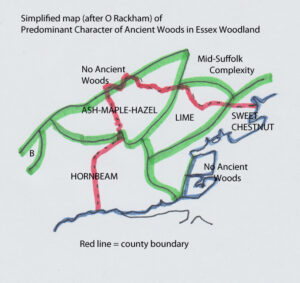
This is not a native tree but behaves as if it is such as in its distribution. Sweet Chestnut, Castanea sativa, originally was native to southern Europe, north Africa & west Asia. Whilst it is across the UK, most is found in the south east & south of England, historically mainly managed as coppice. Coppice is where trees have been cut near ground level, and numerous regrowth stems grow from there. Across the centuries coppice management has provided crops of poles on a regular cycle for firewood, fencing etc. Sweet Chestnut has long been believed to have been brought by the Romans and its pattern in Essex does fit with that, being on the east coastal strip where it is the predominant species in woodland (see below map). The Roman capitol for a period was Colchester, with Brightlingsea & Mersea as Roman settlements.
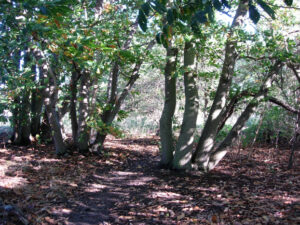
The bark in a mature Sweet Chestnut has long deep fissures that spiral around the tree & can be seen well in one in the gardens of Moverons. In Wicks & Lodge Woods are standard trees plus numerous coppice stools. Some large Sweet Chestnut coppice stools of significant age can be seen at the top of the permissive path through the Long Plantation that border Moverons & Lodge Farm in Brightlingsea (pictured above right).
Oak
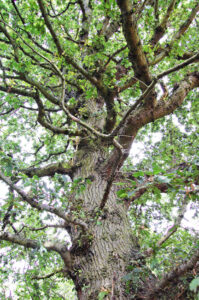
Brightlingsea has some grand standard oaks (ie not coppiced or pollarded), one as a street-side tree stands proud on the grassed area at the west end of Spring Road (which hosts some knopper galls each year), another is by Springmead Gardens on the top of Ladysmith Avenue. The ancient Wicks & Lodge Woods also hold some fine standard oaks, one stand alone at the top entrance of Wicks Wood, others amid the mixed coppice (including the standard oak in the picture below). Similarly, Thicks Wood overlooking Alresford Creek has coppice with standards. In these woods the oaks are Pendunculate Oaks Quercus robur, (Britain has two native oaks the Pendunculate & the Sessile Quercus petraea).
Pollard Oaks
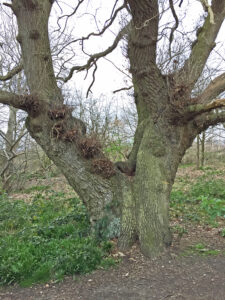
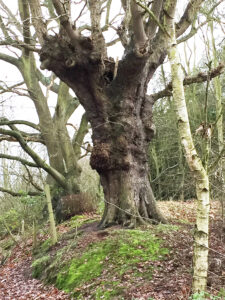
Brightlingsea has a significant small group of veteran pollard oaks that follow a rambling line down the middle section of the ‘Long Plantation’ (pictures below). They were threatened with removal by quarry activity a few years ago, but I was able to save them with discussions with the company and Natural England.
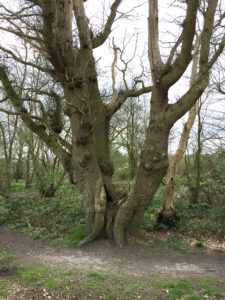
There are also a couple of veteran pollards at Marsh Farm, on a historic earth bank (picture below).
Eucalyptus
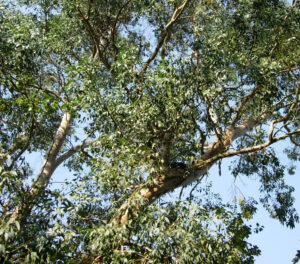
Despite being non-native, the Eucalyptus Cider Gum Trees Eucalyptus gunnii found growing in Brightlingsea have a particular significance. These Tasmanian trees were introduced by Brightlingsea’s “Squire” Mr John Bateman. They were first discovered in Tasmania in 1840. He grew them from seed he received, & planted out 60 seedlings in 1887. Dr Dicken incorrectly recorded that Mr Bateman was the first to introduce them to England. However, the tree’s botanist finder Ronald Gunn introduced Joseph Hooker to it, & Hooker formally described it in 1844 naming it E. gunnii after Gunn. Through Joseph or his father William Hooker it was first grown at Kew & planted out in 1845 or 46, it died in 1908. In 1912 the book “Trees & Shrubs of Great Britain & Ireland” noted “The most remarkable plantation that is known in England was made by the late John Bateman Esq. of Brightlingsea Hall Farm”. Stan Jermyn’s 1974 “Flora of Essex” noted “Some of these trees are now of very great size & they have survived the rigours of our English winters, in this rather bleak spot near the east coast for 85 years, including the arctic conditions of 1962-3”. Well, it is now nearly 140 years since they were first planted in Brightlingsea, and they are still going strong. Their distinctive flaking bark & characteristic leaves make them easy to spot. Dr Dicken noted in 1913 “that around Brightlingsea Hall there were some fine specimens, in the Essex Flora of 1974 their presence was recorded from Lodge Farm (the former manor house). They grow along the garden boundary & in the garden of “Greythorpe”, the old early 19th century vicarage (near Strangers Corner on Church Road). When I lived there, I found that self-sown seedings would occasionally sprout in the gravel drive. It is notable that in Gravesend, the wood bounding Moverons Lane, beyond the end of All Saint’s Churchyard, some have fallen over flat, but new trunks have grown up from fallen trunk (in the same manner as in willow species).
Picture of a Brightlingsea Eucalyptus gunnii in Greythorpe garden (former vicarage, Church Road near All Saints Church).
Author: Roger Tabor MPhil CBiol FRSB FBNAhc FCFBA FLS, is national President of the British Naturalists’ Association which was founded in 1905. He is a biologist, naturalist, TV broadcaster & author.
Essex Branch of the British Naturalists’ Association
Email: essex@bna-naturalists.org
Essex Branch Website: https://essex.bna-naturalists.org
National BNA Website: https://bna-naturalists.org
Essex Branch Twitter: @essexbna